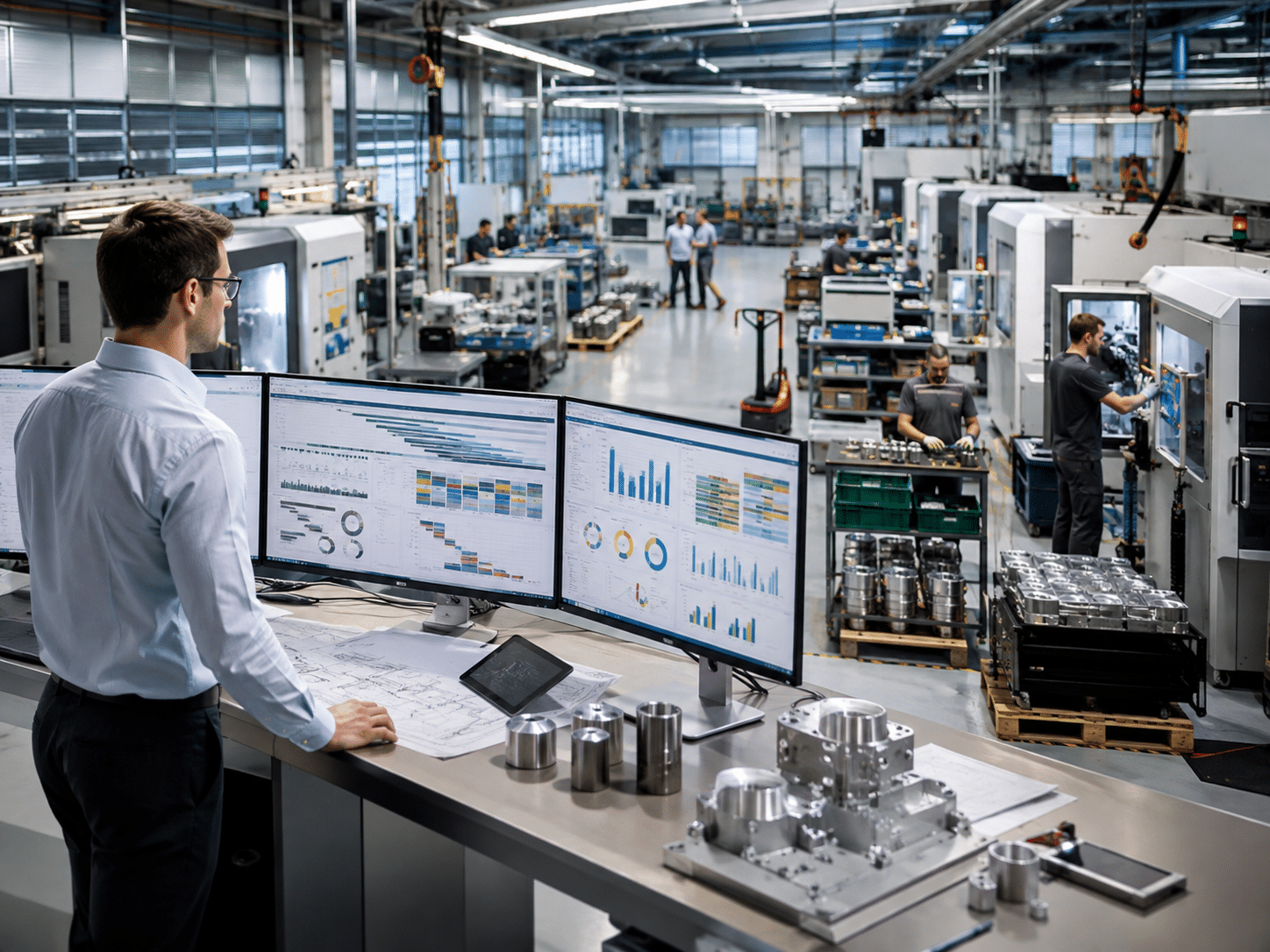



In an industrial company, unforeseen events are common: a machine breaks down, a delivery is delayed, an urgent order comes in, or several staff members are absent. The production planner must therefore re-prioritise in order to maintain production under the best possible conditions.
His role involves coordinating orders, resources, production capacity and deadlines. He ensures that the company produces the right quantities at the right time, without overburdening the teams or tying up machinery and stock unnecessarily.
What is a production planner?
The production planner acts as the link between business requirements and the company’s actual capacity.
Based on customer orders and sales forecasts, he determines what needs to be manufactured, in what quantities and when. He also checks the availability of raw materials, components, machinery and staff.
He works regularly with :
- sales; ;
- purchases; ;
- logistics; ;
- workshop managers; ;
- production teams; ;
- industrial methods; ;
- suppliers.
His role is not simply a matter of ticking boxes. He must anticipate the risks, identify any constraints and adapt the programme as the situation changes.
In a small business, a single person may be responsible for both planning and scheduling. In a larger organisation, these roles are often shared amongst several staff members.
What are the responsibilities of a production planner?
Responsibilities may vary depending on the company and sector, but they generally revolve around the following tasks.
Analysing orders and forecasts
The planner analyses confirmed orders, sales forecasts and internal requirements. This analysis enables them to estimate the volumes to be produced over the coming weeks or months.
He must distinguish between actual requirements and estimates in order to avoid either over-production or, conversely, a shortage of goods.
Draw up the production plan
He then draws up a realistic production plan, taking into account:
- machine capacities; ;
- staff availability; ;
- production times; ;
- scheduled maintenance; ;
- lead times; ;
- customer priorities.
The aim is to balance the workload with the company’s capacity.
Check the available resources
Before confirming a programme, the planner checks that the necessary resources are available.
When the workload exceeds capacity, he may suggest adjusting priorities, rescheduling certain tasks, arranging for overtime, outsourcing work or negotiating a new deadline.
These decisions are taken in consultation with the relevant managers.
Tracking materials and stock levels
Production cannot begin without the necessary raw materials or components.
The planner therefore monitors stock levels and liaises with the purchasing and logistics departments. Their aim is to avoid stock-outs without holding excessive quantities that would increase storage costs.
Keeping data up to date
The quality of the plan depends directly on the reliability of the information recorded in the ERP system.
The planner can check or update:
- bills of materials; ;
- production times; ;
- operational ranges; ;
- batch sizes; ;
- the capacities of the posts; ;
- supplier lead times.
Incorrect data may result in a delay, an unnecessary purchase or an inaccurate estimate of the workload.
Dealing with the unexpected
Breakdowns, staff absences, quality issues, urgent orders and supplier delays regularly force us to revise the schedule.
For example, when a component does not arrive on time, the planner can bring forward another production run using materials that are already available. This prevents a machine from lying idle whilst minimising the impact on lead times.
Track performance
The planner compares the forecasts with the actual output.
In particular, it includes the following:
- adherence to deadlines; ;
- delays; ;
- quantity discrepancies; ;
- stock levels; ;
- capacity utilisation; ;
- the reasons for delays or stock-outs.
This data enables him to improve future plans and identify processes that need to be addressed.
Scheduler and planner: what are the differences?
The two roles are similar and may overlap, depending on how the company is organised. The main difference generally lies in the scope of the work.
The planner focuses primarily on the requirements for the coming weeks or months. They aim to balance orders, capacity and supplies.
The scheduler plays a greater role in day-to-day operations. They determine the precise order in which operations and production orders are to be carried out.
| Criterion | Planner | Scheduler |
| Horizon | Medium term | Short term |
| Objective | Balancing needs and capabilities | Organising the execution |
| Decisions | Volumes, resources, workload | Running order and start time |
| Contacts | Sales, purchasing, logistics, production | Workshop staff, operators, line managers |
| Tools | ERP, forecasts, workload plans | ERP, workshop monitoring, production orders |
| Unforeseen circumstances | Capacity or supply risks | Day-to-day breakdowns and emergencies |
This distinction is not the same everywhere. In some SMEs, a single person fulfils both roles.
Why is this profession important to Swiss industry?
Swiss industry is characterised by high quality standards, technical products and high production costs.
Poor planning can lead to:
- delivery delays; ;
- excessive stock levels; ;
- under-utilised machines; ;
- more expensive urgent purchases; ;
- disorganisation within teams; ;
- a decline in customer satisfaction.
The constraints vary from sector to sector.
In the watchmaking industry, it is necessary to manage high-value components and specialised processes. In the pharmaceutical sector, planning must take into account strict standards, quality controls and downtime for cleaning equipment. In the food and drink industry, use-by dates and product freshness play a key role.
Precision engineering, electronics, machinery and medical technologies also present their own challenges. The planner must therefore have a thorough understanding of the processes within their sector.
What skills do you need?
The role requires technical, organisational and interpersonal skills.
Technical skills
The planner must understand industrial processes and know how to use:
- an ERP system, such as SAP or an equivalent tool; ;
- Excel and analytical tools; ;
- dashboards; ;
- stock data; ;
- load plans; ;
- production indicators.
He must also be able to interpret the data and assess the implications of a decision for subsequent operations.
Organisational skills
He must be able to anticipate, prioritise and deal with several constraints at the same time.
Rigorous planning is essential, as a planning error can disrupt several departments or bring a production line to a standstill.
Personal qualities
The planner liaises with people whose priorities may differ.
The sales department sometimes wants to speed up a delivery, whilst the workshop has to work within its technical constraints. The planner must explain the implications of each decision and propose a realistic solution.
Communication, composure, adaptability and the ability to make decisions are therefore important.
Do you recognise yourself in this profile, or would you like to develop these skills to advance your career in the industry? Find out how NCAcademy’s training can help you master the key tools of production planning.
What is the salary for a production planner?
Remuneration varies according to experience, qualifications, canton, sector and level of responsibility.
According to Jobs.ch, the average annual salary for a «Production Planner» in Switzerland is around CHF 84,500 gross. For professionals with more than twelve years’ experience, it can reach around CHF 95,550 gross per year.
Jobup’s data for the role of process agent – which may include responsibilities similar to those of a planner – indicates an average annual salary of around CHF 84,000 gross, including the thirteenth month’s salary and bonuses.
Michael Page offers a wider range, from CHF 75,000 to CHF 130,000 gross per year, depending on the role, experience and company.
These figures are for guidance only. Salary may depend, in particular, on:
- the number of years’ experience; ;
- of the qualification; ;
- in the industrial sector; ;
- of the canton; ;
- the size of the company; ;
- proficiency in an ERP system; ;
- spoken languages; ;
- team responsibilities.
How do you become a production planner?
There is no single path.
Many professionals start out by gaining a Federal Certificate of Competence (CFC) in a technical, industrial or logistics field, for example as a logistics specialist, a multi-skilled mechanic or an automation engineer.
Hands-on experience helps one to understand the constraints faced by machinery, material flows and production teams.
Further training can then make it easier to move into this role. Possible career paths include:
- the Federal Certificate in Process Operations; ;
- the Federal Certificate in Logistics; ;
- the Higher Vocational Diploma (ES) in Process Technology; ;
- specialised training in production planning; ;
- a degree from a university of applied sciences or a university in industrial or mechanical engineering.
Requirements vary from company to company. Some prioritise practical experience, whilst others require higher education for roles involving greater responsibility.
Learning whilst continuing to work
On-the-job training enables people to develop their skills without interrupting their work.
In particular, it offers the following options:
- maintain one’s income; ;
- apply what they have learnt straight away; ;
- to make progress at a pace that is compatible with their job; ;
- showcase your experience.
Under certain conditions, candidates taking a preparatory course for a federal examination may apply for a grant from the Confederation covering up to 50 % of the eligible costs.

Conclusion
The production planner ensures consistency between orders, resources, supplies and deadlines.
His role requires a good understanding of industrial processes, proficiency in management tools and the ability to react quickly to unforeseen circumstances.
For professionals with a background in production, logistics or a technical role, this role can represent a move towards a more cross-functional position.
Sources used
- Antaes, Production Planner – Watchmaking (M/F), 2026.
- B2Wise, Implementing DDMRP: a step-by-step guide and best practices, 2026.
- Examen.ch, Process Officer (male) / Process Officer (female).
- ESG / SFB, Federal Certificate in Process Operations (m/f).
- Gateway.one, Job title: BF Process Operator.
- Jobs.ch, What is the salary for a Planner in Switzerland?
- Michael Page, Salary Survey – Switzerland – Supply Chain.
- Orientation.ch, Industrial Production Manager (DF).
- Sigma, Jobs in watchmaking: vacancies in Switzerland.
- SuCh Consulting, Optimise Your Supply Chain Using the DDMRP Method, 2024.
- TeamWork, SAP Digital Supply Chain.